

Child Support Grant Update 2026: New Payment Amount, Eligibility Changes and What Families in South Africa Should Expect
Child Support Grant Update 2026: New Payment Amount, Eligibility Changes and What Families in South Africa Should Expect
The message came through on a Tuesday morning in a community WhatsApp group in Khayelitsha. Someone had posted that the Child Support Grant was increasing in April 2026. Within minutes, thirty replies had piled up. Half the group was celebrating. The other half was asking whether it was real, how much the increase actually was, and whether they needed to do anything to receive it.
That scene plays out in communities across South Africa every single time SASSA announces a grant adjustment. And the confusion is completely understandable. Information travels fast but accuracy travels slowly. By the time the correct figure reaches the person who needs it most, three wrong versions have already taken root.
So let us set the record straight on the Child Support Grant for 2026 — what the new amount is, when it kicks in, who qualifies, and what families should actually expect in terms of practical changes.
What Is the New Child Support Grant Amount for 2026?
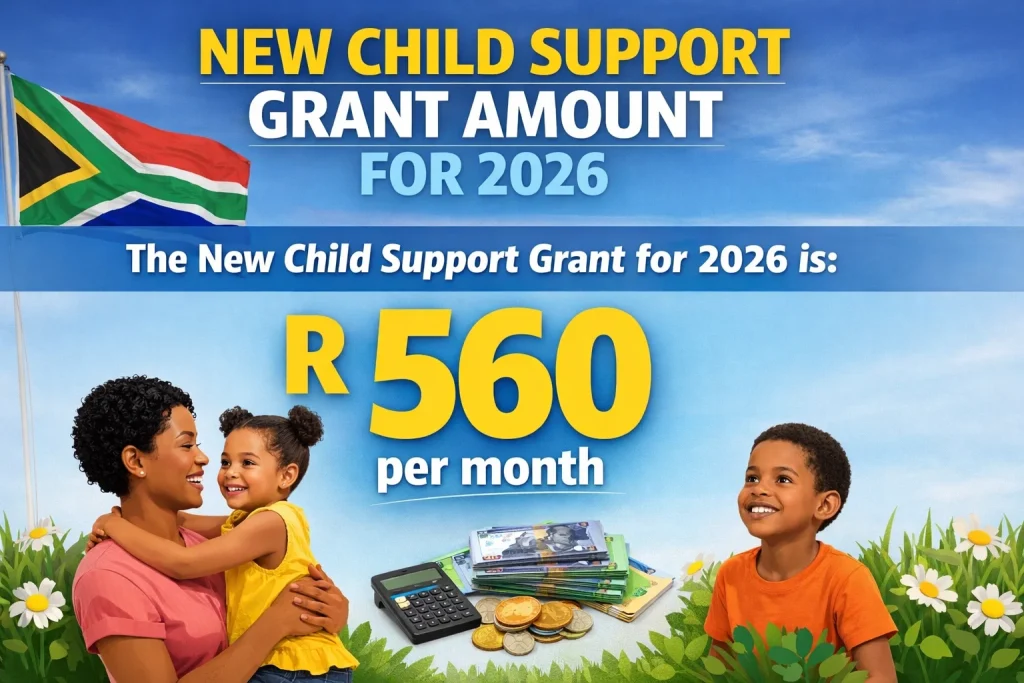
The Child Support Grant increased to R560 per child per month from April 2026, up from R530 in the previous financial year. This R30 increase forms part of the annual adjustment announced in the national budget, which typically aligns grant increases with the Consumer Price Index to partially offset the effects of inflation.
To put that in perspective: R30 extra per month sounds modest. For a caregiver supporting three children on the Child Support Grant, that is R90 more per month — R1,080 over the course of the year. In households where every rand is allocated before it arrives, that difference is real. It covers two loaves of bread a week. It covers a school transport contribution. It is not life-changing, but it is not nothing either.
Here is the honest and slightly uncomfortable truth about these annual increases, though. South Africa’s headline inflation for food and non-alcoholic beverages has consistently run above the overall CPI figure. That means grant increases that track general inflation are still leaving grant-dependent households falling behind in real purchasing power on groceries specifically. The increase helps. It does not fully compensate.
Who Qualifies for the Child Support Grant in 2026?
The Child Support Grant is paid to the primary caregiver of a child under 18 years old. The caregiver does not have to be the biological parent. Grandparents, aunts, uncles, and legal guardians all qualify, provided they can demonstrate that they are the primary caregiver and that they meet the means test.
The means test thresholds for 2026 are as follows:
- Single caregiver: Annual income must not exceed R57,960 (R4,830 per month)
- Married caregiver or caregiver living with a partner: Combined annual income must not exceed R115,920 (R9,660 per month)
One thing that regularly catches people out: the means test applies to the caregiver’s income, not the biological parent’s income. If a grandmother is raising her grandchildren and her own pension income falls below the threshold, she qualifies even if the child’s biological parents earn above the limit and are absent from the household.
This distinction is not always explained clearly at SASSA offices, and it has resulted in unnecessary rejections that get overturned on appeal. If you were rejected based on an incorrect income assessment, the appeals process exists precisely for this situation.
How Does the Increase Reach You — Do You Need to Apply Again?
No. If you are already receiving the Child Support Grant, the increased amount loads automatically from April 2026. You do not need to reapply, visit a SASSA office, or complete any additional paperwork to receive the higher amount.
The updated payment reflects in your account or on your SASSA Postbank Gold Card from your April payment date onwards, following the standard payment schedule where Children’s Grants are paid on the third payment day of each month.
The only situation where action is required is if your banking details have changed, your SASSA card has expired or been lost, or you have recently moved and need to update your personal information. In those cases, visit your nearest SASSA office with your ID and relevant documentation before your April payment date to ensure no disruption.
Can a Caregiver Claim for Multiple Children?
Yes. The Child Support Grant is paid per qualifying child, not per household. A caregiver looking after four children under 18 receives the grant for each of them individually, provided each child’s application has been approved.
This is one of the most practically significant aspects of the grant that many new caregivers are not aware of when they first apply. Someone raising twins, or who has taken in siblings, should be applying for each child separately. A single application for “the children” is not how the system works.
The process requires a separate application form per child, with that child’s birth certificate, and confirmation that the caregiver is the primary care provider for each one. It takes longer at the SASSA office. It is worth it.
There is a cap worth knowing about: a caregiver can receive the Child Support Grant for a maximum of six children. In practice, very few households hit this ceiling, but for those raising large sibling groups following parental death or abandonment, it is a relevant limit.
What About the Foster Child Grant — Is That Different From the Child Support Grant?
This question comes up constantly and the confusion causes real financial harm.
The Foster Child Grant and the Child Support Grant are two separate grants with different qualifying criteria, different amounts, and different application processes.
The Foster Child Grant is R1,180 per month as of 2026, more than double the Child Support Grant. It requires a court order placing the child in your care — which means a formal foster care court process through the Children’s Court, not just an informal arrangement where a relative is raising a child.
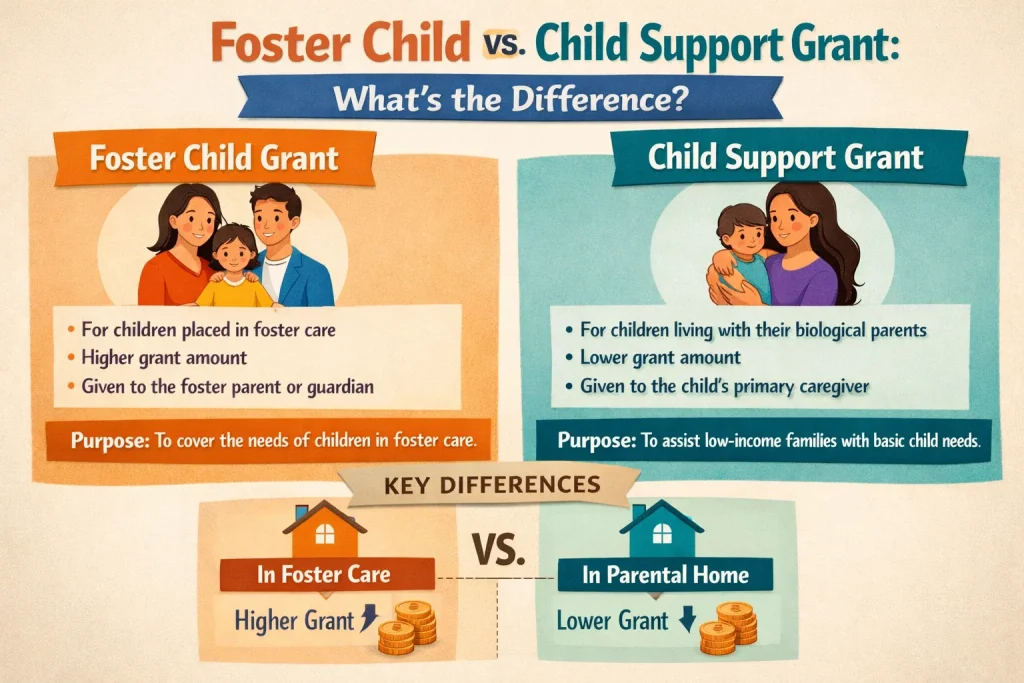
Here is where the harm happens: many relatives who are informally raising children who are not their own apply for and receive the Child Support Grant when they could, with the correct legal process, qualify for the significantly higher Foster Child Grant. The legal process is more demanding. It requires a social worker assessment and a court appearance. But for long-term caregiving situations, the financial difference is substantial.
If you are a grandparent, aunt, uncle, or sibling raising a child under a permanent informal arrangement, speak to a social worker at your nearest Department of Social Development office about whether formalising the foster care arrangement makes financial sense for your household.
What Happens to the Child Support Grant When a Child Turns 18?
The Child Support Grant ends automatically on the child’s 18th birthday. SASSA’s system triggers the termination based on the date of birth on record.
This transition catches families off guard, particularly when the child is still in school and the family is genuinely dependent on that income. The grant does not extend for matriculants or students. It ends at 18, full stop.
Planning for this is difficult when household income is already tight, but it is worth building awareness into your budgeting from around the time a child turns 17. The gap left by a terminating grant is real and immediate.
If the child themselves has a disability that requires ongoing support after age 18, they may qualify for the Disability Grant in their own right. That application needs to be initiated before their 18th birthday to avoid a payment gap.
How Do You Apply for the Child Support Grant If You Have Not Yet Done So?
The application process in 2026 has remained largely consistent, with the addition of biometric registration requirements that are rolling out across the grants system from April 2026.
To apply, visit your nearest SASSA office with the following:
- Your South African ID document (green barcoded ID or Smart ID card)
- The child’s birth certificate (original)
- Proof of your residential address (dated within three months)
- Proof of income or a sworn affidavit confirming you have no formal income
- The child’s Road to Health booklet (recommended but not always mandatory)
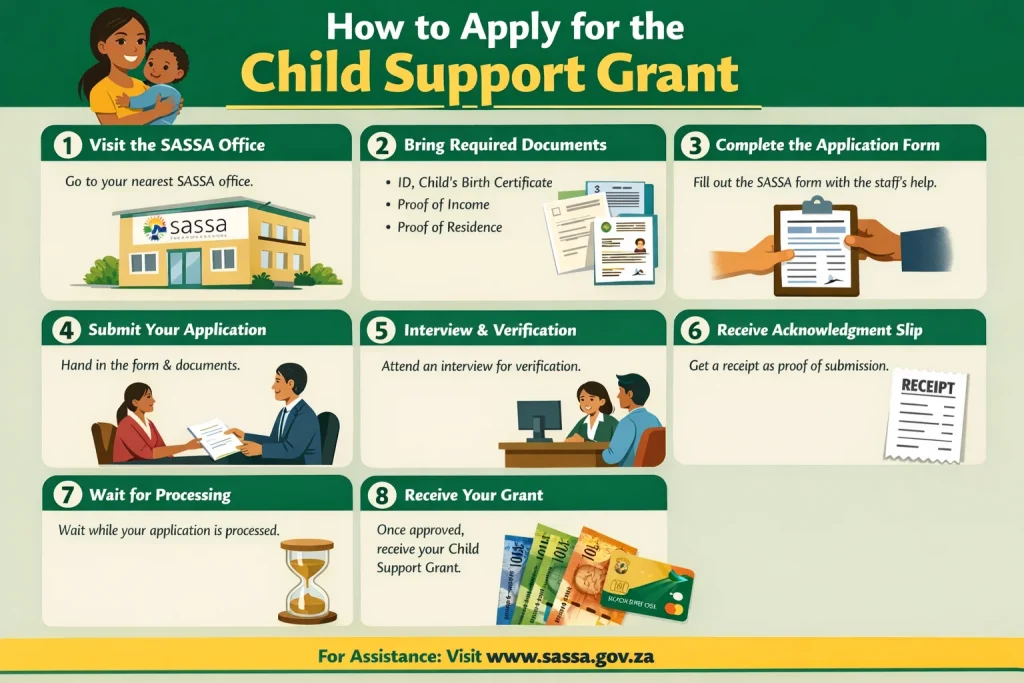
If you are not the biological parent, bring the documentation that establishes your relationship to the child and confirms your primary caregiver role. An affidavit from a commissioner of oaths confirming the caregiving arrangement is useful if no formal court order exists.
Processing time for a new application is officially 90 days, but approved applications often come through sooner. Keep your reference number from your application date and follow up at the 45-day mark.
Frequently Asked Questions About the 2026 Child Support Grant
Is R560 the final amount for the entire 2026 year, or does it change again in October?
The April 2026 increase is the primary annual adjustment. SASSA does not typically implement a second mid-year increase. The R560 amount should hold through to the next annual budget cycle.
Can the child’s father claim the Child Support Grant if he is the primary caregiver?
Yes. The grant is not restricted to mothers. Any primary caregiver, regardless of gender, can apply and receive the grant provided they meet the qualifying criteria.
What if the child does not have a birth certificate?
This is a real barrier for many families. Without a birth certificate, the application cannot proceed. SASSA does not have the authority to waive this requirement. The solution is to apply for a birth certificate at Home Affairs before submitting your SASSA application. Community advice offices can assist with this process if the late registration of birth is required.
Can I receive the Child Support Grant if I am unemployed and receiving the SRD R370 grant?
Yes. The SRD grant does not disqualify you from receiving the Child Support Grant. They serve different purposes and have separate means tests
What if my child lives with me part of the time and with their other parent part of the time?
SASSA grants the payment to the primary caregiver — the person with whom the child lives the majority of the time. Shared custody arrangements do not allow both parties to claim simultaneously for the same child.
What Families Should Realistically Expect in 2026
The R560 Child Support Grant will reach approximately 13 million children across South Africa. It remains the most widely accessed social grant in the country’s history, and for many households it is the only predictable income that arrives every month without fail.
The 2026 increase is real and welcome. But families should also be aware of two things running parallel to it. First, the biometric registration requirement affecting all grant recipients from April 2026 means caregivers need to ensure their identity is registered in the new system to avoid payment disruption. Second, SASSA’s annual review processes are becoming more rigorous, and caregivers who have not updated their details recently may face verification requests.
The families who navigate this system most successfully are the ones who treat their SASSA relationship as an active one — not a set-and-forget arrangement. Keeping your contact details current, checking your payment dates, and knowing your rights if something goes wrong are the small habits that protect a household’s most reliable income source.
If this post answered questions you have been sitting with, share it with someone in your network who is raising children on the Child Support Grant. The information gap is the most solvable problem in the whole system — and closing it starts one conversation at a time.

