

Ramaphosa Announces Major SRD Grant Changes: What the Overhaul Means for 8 Million Jobseekers
Ramaphosa Announces Major SRD Grant Changes: What the Overhaul Means for 8 Million Jobseekers
South Africa has been sitting at an uncomfortable crossroads for years. The unemployment rate hit 31.9% in Q3 of 2025 using the narrow definition — and ballooned to 42.4% under the expanded measure that counts discouraged work seekers. For millions of people, the R370 Social Relief of Distress grant has been the only thing standing between their family and hunger. But here’s what nobody tells you: a grant that simply pays people to stay poor was never going to fix unemployment. Ramaphosa finally said it out loud.
What Ramaphosa Actually Announced — And Why This Time Feels Different
Speaking at the News24 On the Record Summit on 19 March, President Ramaphosa confirmed that the SRD grant overhaul will produce a dedicated jobseeker’s grant — a structure fundamentally different from passive income relief. His words were pointed and deliberate: “By redesigning the Social Relief of Distress Grant, we will ensure that those receiving the grant have access to a wide range of support to search for work and to sustain a livelihood.”
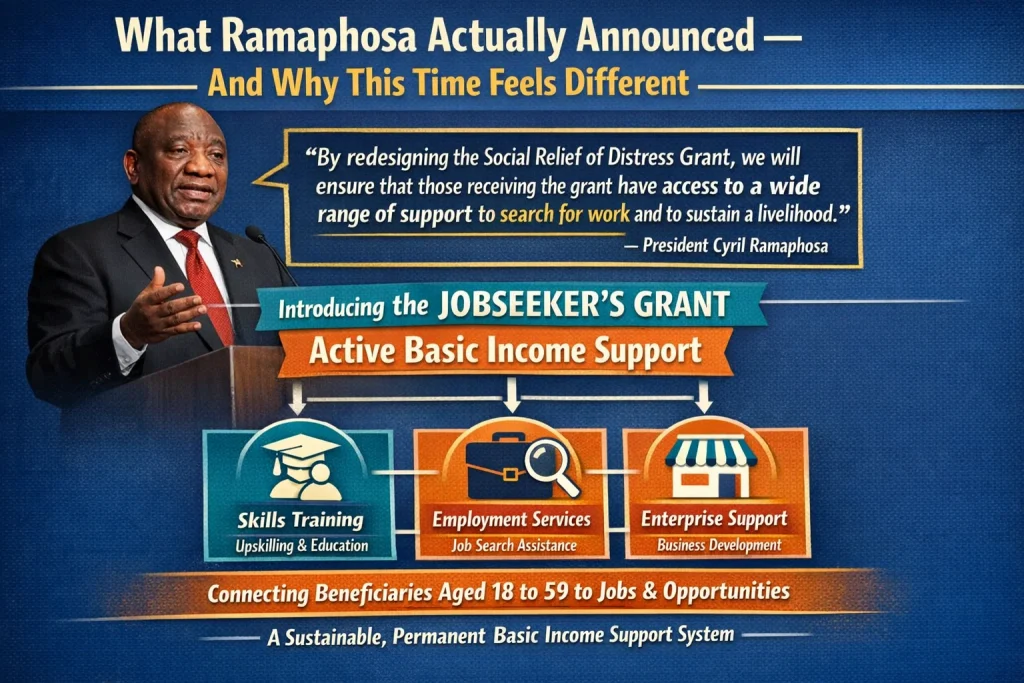
That is a meaningful shift in language. Previous SONA addresses spoke vaguely about “reform.” This announcement names a destination: a Basic Income Support (BIS) system with active employment linkages built in.
The Department of Social Development confirmed the SRD grant serves as the base for the new BIS system, with macroeconomic models currently being tested to make it a sustainable, permanent support structure. The redesign is expected to align with linking beneficiaries aged 18 to 59 to employment, training, and enterprise opportunities.
The R370 Grant Is Not Going Anywhere — Yet
Before panic sets in: the current R370 grant has been extended until March 2027, as announced in Ramaphosa’s State of the Nation Address. National Treasury allocated an additional R36.4 billion to extend payments until 31 March 2027 at the current R370 per month per beneficiary.
That is the floor. The ceiling is what is being built right now.
The Hard Truth Civil Society Won’t Let Anyone Forget
Here is the part that gets glossed over in the celebratory coverage. Civil society organisations say the announcement stopped short of meaningful reform. Human rights group Black Sash warned that extending the grant without increasing its value or removing systemic barriers does little to address deepening poverty.

They are not wrong. R370 in 2026 buys considerably less than R370 did when the grant launched during COVID-19. The value has not moved while the cost of bread, transport, and electricity has.
What Comes Next
Consultations between the Department of Social Development and the National Treasury began in March 2026, focusing on funding and implementation. A draft policy has already been reviewed, with government aiming to finalise discussions by the end of the month.
Ramaphosa also highlighted the Presidential Employment Stimulus, which has generated more than 2.5 million public and social employment opportunities since 2020, and the Youth Employment Service, which has provided work experience to more than 220,000 young people. The jobseeker’s grant is intended to feed into this wider ecosystem — not operate in isolation.
The redesign is overdue, the intent is right, and the pressure from civil society is healthy. Whether implementation matches ambition is the question South Africa has been asking about its social policy for a decade. The answer is still being written.


