

Latest SASSA Care Dependency Grant Changes 2026: Essential Info for Caregivers Before Payments
Latest SASSA Care Dependency Grant Changes 2026: Essential Info for Caregivers Before Payments
A caregiver in Mitchells Plain spent three months in 2025 trying to understand why her Care Dependency Grant had been suspended. Her child had not changed. Her circumstances had not changed. What had changed was a documentation requirement she had never been told about. Three months without that payment meant three months of impossible choices about medication, food, and transport.
That story is not unique. It plays out in communities across South Africa every single month. And the reason it keeps happening is not that caregivers are careless. It is that the information they need arrives late, gets filtered through rumour, or never reaches them at all.
So let us fix that right now, for 2026.
What Is the SASSA Care Dependency Grant and Who Qualifies in 2026?
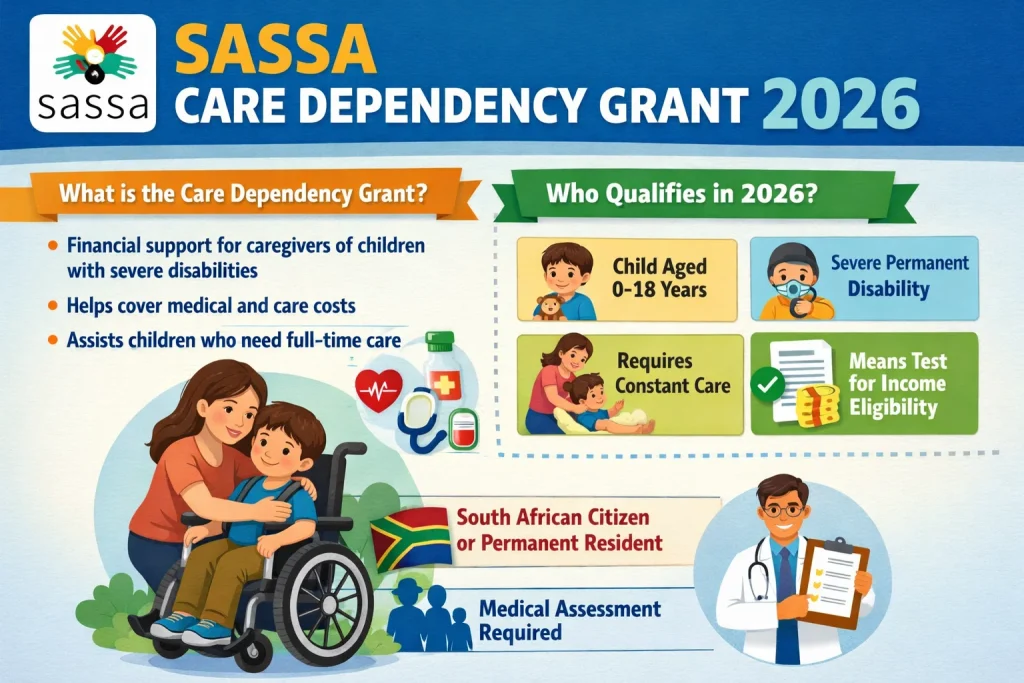
The Care Dependency Grant is a monthly payment of R2,230 (as of the 2025/2026 financial year) designed to support caregivers of children with severe disabilities. The child must be between 1 and 18 years old, require full-time care due to a physical or mental disability, and the caregiver must meet the means test requirements.
Here is what many caregivers do not realise: the grant is means-tested against the caregiver’s income, not just the child’s condition. A household income above the threshold disqualifies the application even if the child’s need is undeniable. This catches people off guard, particularly in households where a second income recently changed.
The qualifying conditions require a medical assessment confirming the child needs permanent, full-time care. “Permanent” is the word that causes the most confusion. Many caregivers assume any serious disability qualifies. SASSA requires documentation that the condition is not temporary and that the care requirement is continuous.
What Has Actually Changed for the Care Dependency Grant in 2026?
The most significant shift caregivers need to understand going into 2026 is around the reassessment process. SASSA has been tightening its review cycles, and Care Dependency Grant recipients are being called in for reassessments more frequently than in previous years.
This is not arbitrary. It is part of a broader grants system audit that began in late 2023 and has been rolling forward. The practical impact is that caregivers who have held this grant for several years without a formal review are now receiving reassessment notices. If you have received one, do not ignore it. Missing a reassessment appointment does not just delay your payment. It suspends it.
The updated medical assessment forms also require more detailed information from treating practitioners. A general practitioner’s letter is no longer sufficient in many cases. SASSA increasingly requires assessments from specialists — paediatricians, neurologists, or occupational therapists — depending on the nature of the disability.
This is expensive. A specialist consultation in the private sector can cost between R800 and R2,500. For a caregiver already stretched by the demands of full-time childcare, this is a serious barrier. The solution, and this matters, is to use public health facilities where specialist assessments are available at no cost. Tygerberg Hospital, Charlotte Maxeke, and Steve Biko Academic Hospital all have departments equipped to provide the assessments SASSA requires. The wait times are longer, but the cost is zero.
How Does the Means Test Work and What Are the 2026 Thresholds?
The means test for the Care Dependency Grant in 2026 uses a household income threshold. For a single caregiver, the income limit is R57,960 per year (R4,830 per month). For a married couple or caregivers living together, the combined threshold is R115,920 per year.
Assets are also assessed. The asset limit is R1,227,600 for a single applicant and R2,455,200 for a couple. Property you live in is excluded from the asset calculation, which is one of the more caregiver-friendly aspects of the means test.
Here is the part most people get wrong: SASSA reassesses means test eligibility during the annual review process. A caregiver who qualified three years ago may no longer qualify if household income has changed. Equally, a caregiver who was previously rejected may now qualify if their circumstances have deteriorated. Reapplying after a rejection is always worth doing if your financial position has changed.
What Documents Do You Need for a 2026 Application or Renewal?
Getting documentation right the first time saves months of follow-up. For a new application or a renewal, bring the following to your SASSA office:
- Your South African ID document (original)
- The child’s birth certificate (original)
- The child’s Road to Health booklet if applicable
- A recent medical report confirming the disability and the need for full-time care
- Proof of income (payslips, UIF documentation, or an affidavit if informally employed)
- Proof of residence dated within the last three months
- The child’s medical aid details if applicable
If you are the legal guardian rather than the biological parent, bring your court order confirming guardianship. Without it, SASSA cannot process the application.

Why Do Care Dependency Grant Payments Get Suspended Without Warning?
This is the question I hear most often, and the answer is rarely what caregivers expect. Suspensions happen for three main reasons.
First, the annual review triggers a lapse if the caregiver does not respond in time. SASSA sends notices via post and sometimes via SMS. Post is unreliable in many areas. If you have not updated your contact details with SASSA recently, your notice may have gone to an old address.
Second, a change in the child’s treating practitioner can trigger a flag in the system if the new practitioner’s details do not match what SASSA has on record.
Third, database errors. They exist. They happen. If your payment stops and you have done nothing differently, a system-side error is entirely possible. The resolution requires a visit to your SASSA office, your ID, and patience.
How to Appeal a Rejected or Suspended Care Dependency Grant
You have 90 days from the date of the decision to lodge a formal appeal. This is not optional administrative process. It is a legal right.
Write to the Appeals Tribunal at the Department of Social Development. Your written appeal should include your full name, ID number, the decision you are appealing, and the specific reasons you believe the decision was incorrect. Attach all supporting documentation.
If you are uncomfortable writing the appeal yourself, community advice offices and legal aid clinics can assist. The Black Sash organisation has a long track record of supporting SASSA beneficiaries through exactly this process and operates in most major centres.
Frequently Asked Questions About the Care Dependency Grant in 2026
Can both parents claim the Care Dependency Grant for the same child?
No. Only one caregiver can receive the grant per child at any given time.
What happens to the grant when the child turns 18?
The grant ends automatically at age 18. At that point, the young person may qualify for the Disability Grant in their own right, provided they meet the eligibility criteria.
Can I receive the Care Dependency Grant and the Child Support Grant for the same child?
No. You cannot receive both grants for the same child simultaneously.
How long does a new application take to process?
SASSA’s official processing time is 90 days, but approvals often come through sooner. Keep your reference number from the application date and follow up at the 30-day mark if you have not received communication.
What if my child’s condition improves?
You are legally obligated to inform SASSA if the child’s care needs change significantly. The grant is linked to the ongoing need for full-time care.
Final Thoughts for Caregivers Heading Into 2026
Caring for a child with a severe disability is one of the most demanding roles a person can take on. The Care Dependency Grant exists because the state recognises that. But the system is not intuitive, and it does not hold your hand through the process.
The caregivers who protect their grants are the ones who stay ahead of their reassessment dates, keep their documents updated, and know exactly who to call when something goes wrong.
If your reassessment is due, book your medical appointment now. Do not wait for the suspension notice.
And if you know another caregiver navigating this process, share this with them. The information gap is the biggest problem in the whole system — and we close it one conversation at a time.

