

South Africa SRD Grant to Job Seeker’s Grant: What It Means for Applicants in 2026
For six years, a single text message from SASSA changed everything for millions of South Africans. “Approved. R370 will be paid.” That message kept food on tables, kept children fed, and kept hope alive through a pandemic and beyond. But the government is now saying those days of the flat R370 payout are numbered. A new chapter is coming — and it will look very different.
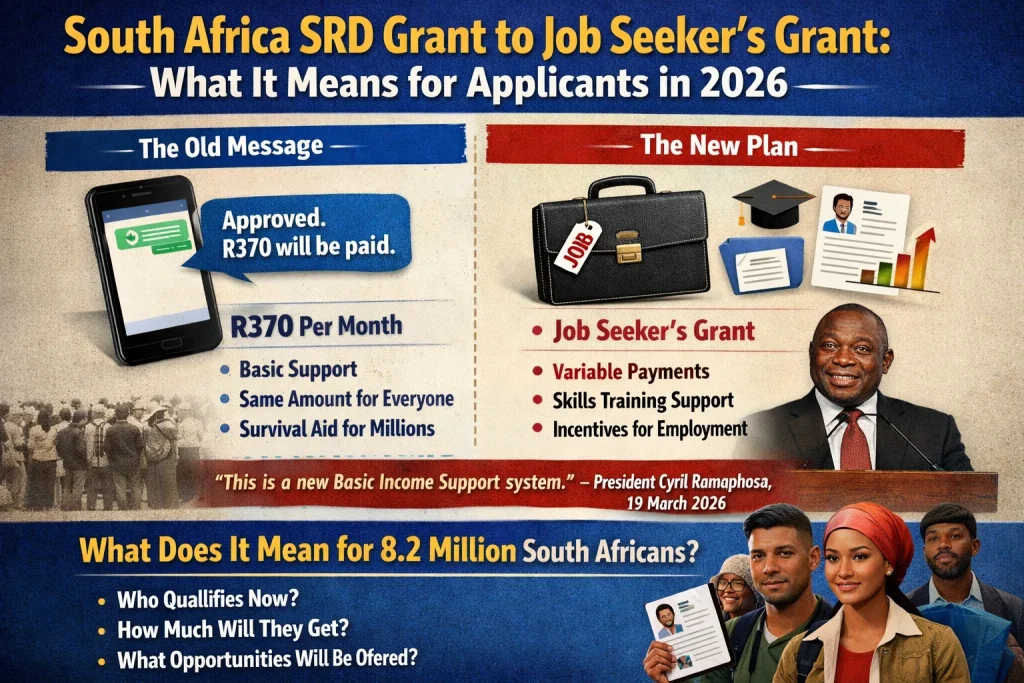
President Cyril Ramaphosa confirmed at the News24 On the Record Summit on 19 March 2026 that the Social Relief of Distress grant will be completely redesigned as a job seeker’s grant, forming the basis of a new Basic Income Support system. That is not a rumour or a policy paper buried in a government archive. It came straight from the president. The question now is: what does that actually mean for the 8.2 million South Africans who depend on this money every month?
What Is Changing and Why It Matters Now
The SRD grant was never meant to last this long. It was introduced as a temporary relief measure during COVID-19 to assist those who lost jobs or were impacted by lockdowns, starting at R350 before rising to R370. Over 8 million South Africans came to depend on it, so it has been extended on an annual basis ever since.
The problem is that dependency and sustainability do not mix well. The grant costs the country roughly R40 billion a year to maintain, a figure the government has flagged as unsustainable without alternative revenue sources. Something had to give. Rather than simply cutting the grant, the government chose redesign.
The SRD grant has been extended until March 2027, following its inclusion in the 2026 national budget. Ramaphosa indicated during his State of the Nation Address that this extension would allow time for the transition to a fully reworked system. So you have approximately twelve months of the current structure remaining. After that, the rules of the game change.
From Cash Relief to Active Support — The Core Shift
Here is what most coverage misses: this is not just a rebrand. The philosophy behind the grant is being flipped on its head.
The current SRD grant asks one question: do you have no income? The new job seeker’s grant will ask something fundamentally different: what are you doing to find work, build skills, or create income?
Finance Minister Enoch Godongwana said the government is “actively exploring various options to better integrate” the SRD grant with employment opportunities, including a job-seeker allowance and other measures as part of a review of Active Labour Market Programmes. “Our goal is to not only provide immediate relief. It is also to create pathways to employment, empowering our citizens to build better futures for themselves and their families,” he said.
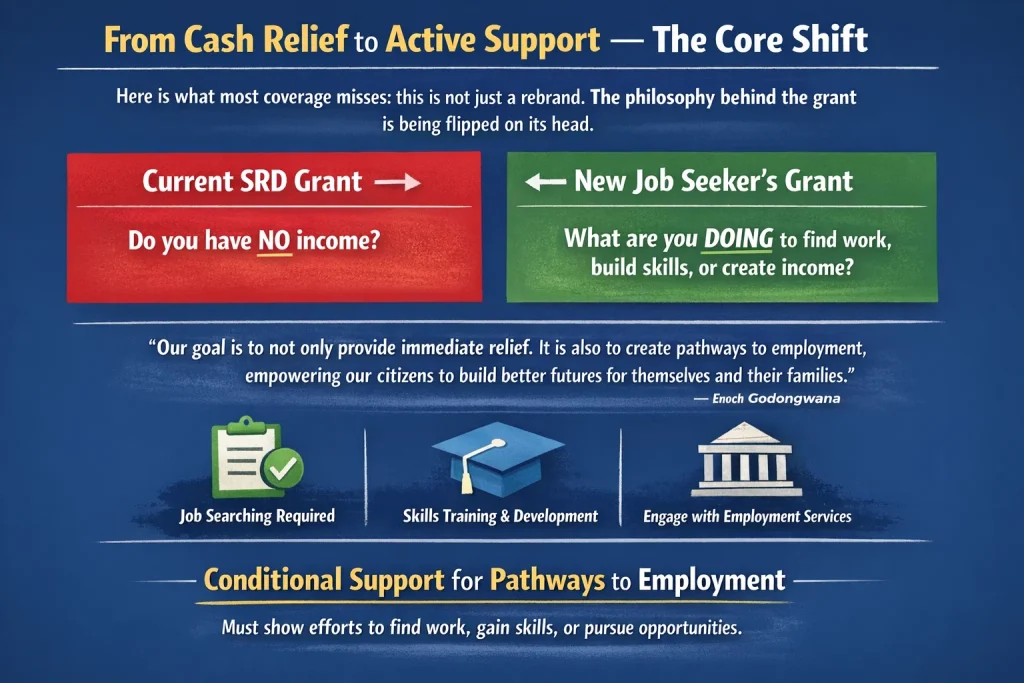
That language signals conditionality. Future recipients may need to demonstrate job-seeking activity, enroll in skills development programmes, or engage with employment services to qualify. Whether that means registering with the Department of Employment and Labour, attending training, or applying to a certain number of jobs per month — the specifics are still being worked out.
How Far Along Is the Process?
Further than most people realise. Consultations between the Department of Social Development and the National Treasury on funding the new Basic Income Support system were scheduled to begin in March 2026. The re-costing of the policy has already been completed and incorporated into the draft policy document, and the intention is to finalise all consultations before the end of March 2026.
That is not distant planning. That is now.
The Department of Social Development is leading the process while working with the Department of Employment and Labour and National Treasury. Once policy proposals are approved by cabinet, the policy will be shared with the public. Until then, the draft details remain inside government corridors.
The Debate Nobody Wants to Have
Civil society is not quiet about this. Researchers and civil society groups argue that linking social assistance to skills development or work-seeking requirements “misunderstands the nature of the crisis.” Their point is blunt: when the expanded unemployment rate sits at 42.4% as of the third quarter of 2025, and youth unemployment exceeds 60% when discouraged work seekers are included, telling people to “find work” as a condition for survival income ignores the structural reality. There simply are not enough jobs. Conditions will not create them.
This is the genuine tension at the heart of the redesign. The government wants fiscal sustainability and a pathway out of dependency. Advocates want unconditional dignity. Both have legitimate points. Neither side will walk away fully satisfied.
SRD Grant vs. Job Seeker’s Grant: Quick Comparison
| Feature | Current SRD Grant | New Job Seeker’s Grant |
| Monthly Amount | R370 | Not yet confirmed |
| Valid Until | March 2027 | Post-2027 onwards |
| Conditions to Qualify | No income, no other grant | Active job-seeking required |
| Skills/Training Link | None | Job placement and SETA training included |
| Enterprise Support | None | Small business support included |
| Monthly Reassessment | Yes, automatic | Expected to continue |
| Annual Cost to Government | ~R40 billion | TBC pending Treasury negotiations |
| Policy Status | Active | Consultation finalising March 2026 |
| Who Oversees It | SASSA | SASSA + Dept. of Social Development + Treasury |
FAQ
Will I lose my SRD payments straight away?
What will the new grant actually require from me?
Who qualifies for the SRD grant right now during the transition?
Can SASSA decline my grant even after previous approvals?
What should I do right now to prepare for the new system?
Register with your nearest Department of Employment and Labour office, explore SETA-funded training in industries actively hiring in your area, and ensure your 13-digit SA ID, a working cellphone number, and a personal bank account in your own name are all current and ready before the new system launches.
About Author