

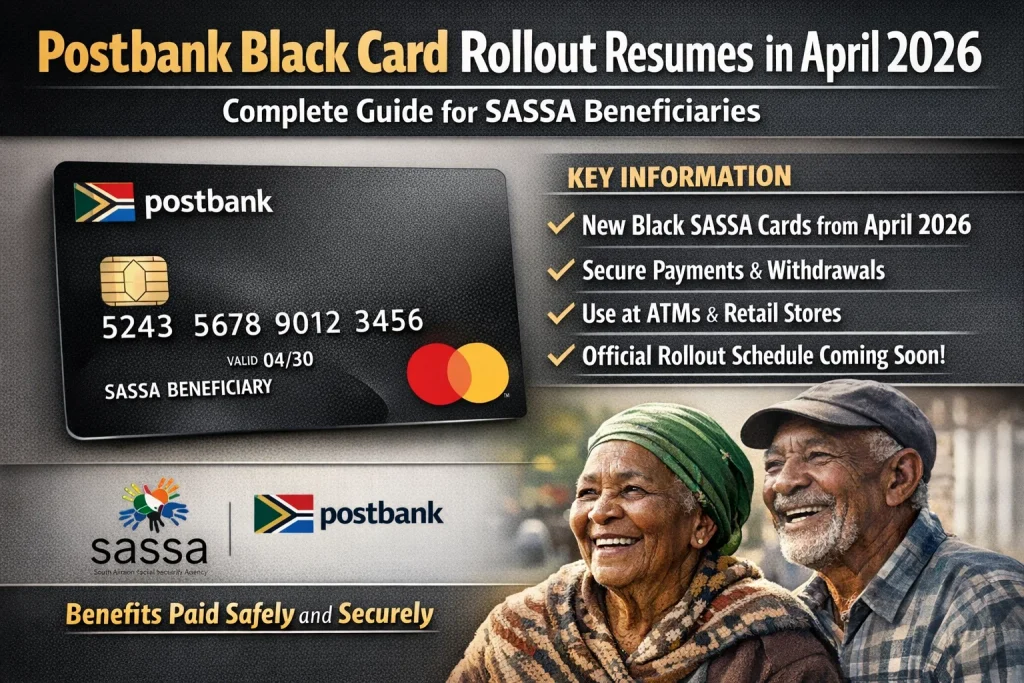
Postbank Black Card Rollout Resumes in April 2026: Complete Guide for SASSA Beneficiaries
Imagine standing at a Shoprite ATM on a Tuesday morning, your grant day, with R0 in your hand because a card you have carried for years simply stopped working. No warning. No SMS. Just a blank screen and a queue of people behind you. That is exactly what happened to thousands of South Africans during the chaotic early stages of the SASSA gold card replacement programme. And right now, with Postbank resuming its black card rollout from mid-April 2026, roughly 600,000 people are at risk of facing that same moment if they do not act fast.
For more information about SASSA Status and SRD Grant Check here:
This is not a drill. This is not another moving deadline. The clock is running — and this time the government means it.
Why Is Postbank Replacing the SASSA Gold Card in the First Place?
Here is the part most articles skip over entirely. The gold card did not get replaced because the government felt like a rebrand. It got replaced because of a serious security crisis that most beneficiaries never heard about.
The switch to black cards was required after a 2021 cryptographic breach compromised the security key used to issue SASSA gold cards. Postbank was subsequently issued notices by the South African Reserve Bank in 2021, 2022, and 2023 to replace all SASSA gold cards with new black cards carrying improved security features.
That is three consecutive years of Reserve Bank warnings before a coordinated rollout even began. Think about that for a moment. Millions of South Africans were using cards built on a compromised security foundation for years while government entities debated logistics. The black card is not an upgrade for the sake of it. It is an overdue security fix.
What Has Happened So Far — and Why the Rollout Struggled
A coordinated rollout only began in 2024, when Postbank launched a campaign to swap cards ahead of a March 2025 deadline. In early 2025, Postbank attempted to migrate millions of beneficiaries, but only about half had switched by the deadline. The rollout was marked by confusion and repeated deadline changes, was widely criticised for being slow and difficult, and system failures meant the rollout struggled to keep pace with demand.
Here is the honest truth about what went wrong. The government set an aggressive deadline without enough replacement sites. Beneficiaries — many of them elderly, many in rural areas — were expected to travel to specific retailers within a narrow window. Long queues formed before sunrise. People left empty-handed. Frustration turned into fear, and fear turned into inaction. Many beneficiaries simply stopped trying and hoped the gold card would keep working.
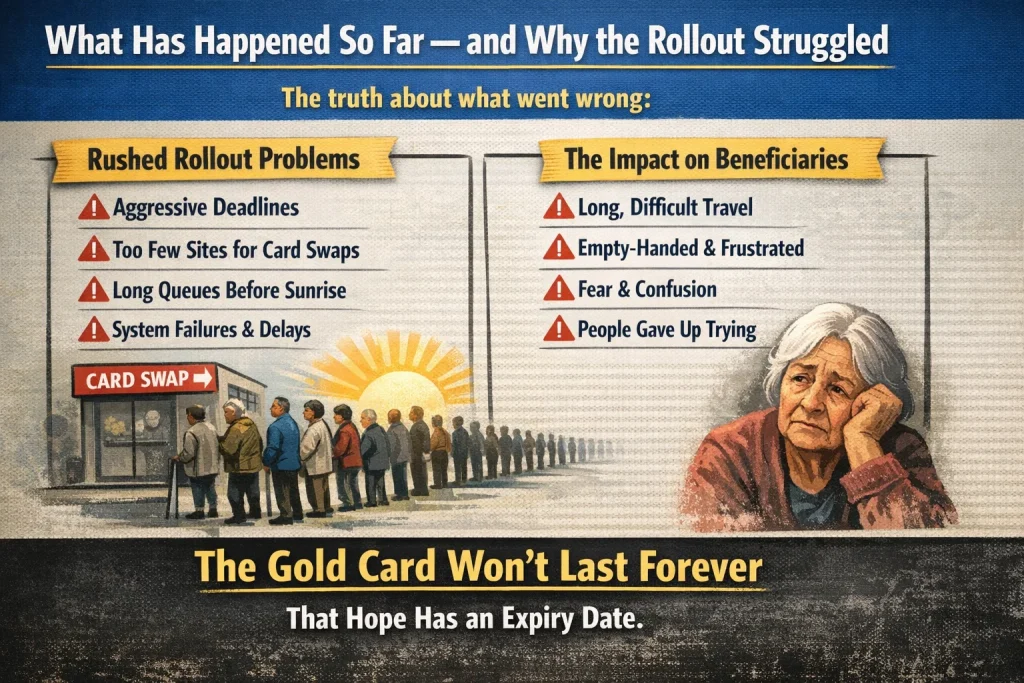
It will not keep working forever. That hope has an expiry date.
What Is Happening From Mid-April 2026
Postbank will resume the rollout of its black cards from mid-April, continuing efforts to replace SASSA gold cards. The rollout will run from mid-April to July 2026. About 600,000 remaining gold cardholders will be called to swap to Postbank black cards in order to continue receiving their social grants.
Approximately 1.5 million social grant beneficiaries had already been issued black cards by 31 March 2025. That means the hardest part of this migration is done. What remains is the final 600,000 — and Postbank, SASSA, and other government entities are expected to work together over the coming months to reach them.
The rollout follows the formal licensing of Postbank as a Financial Services Provider by the Financial Sector Conduct Authority, forming part of efforts to build Postbank into a sustainable and well-governed state-owned retail bank after its separation from the South African Post Office in 2019. This is bigger than a card swap. It is part of transforming Postbank into a fully functioning bank that can serve grant recipients long-term.
Gold Card vs. Black Card: What Actually Changes
| Feature | SASSA Gold Card | Postbank Black Card |
| Security Level | Compromised since 2021 breach | Improved, updated security features |
| ATM Access | Being phased out | Works on all ATMs nationally |
| Retail Payments | Being phased out | Works at all point-of-sale terminals |
| Cost to Replace | N/A | Free for all beneficiaries |
| Documents Needed | N/A | Valid SA ID or temporary ID only |
| Issued By | SASSA (historical) | Postbank at retail replacement sites |
| Validity | Expiring regardless of card date | Active immediately upon issue |
| Replacement Deadline | Multiple missed deadlines | Mid-April to July 2026 final phase |
The Bigger Picture Nobody Is Talking About
Here is a contrarian observation worth sitting with. A series of events has contributed to a decline in the number of social grant beneficiaries using Postbank, with many turning to private banks.That trend is telling. When a rollout is managed poorly, people lose trust — not just in the card, but in the institution behind it. Beneficiaries who switched to Capitec, Absa, or Standard Bank during the confusion are unlikely to return to Postbank without a compelling reason.
The April to July 2026 rollout is therefore about more than replacing cards. It is Postbank’s chance to prove it has learned from the chaos of early 2025. Smoother queues, clearer communication, and accessible sites will determine whether Postbank rebuilds the trust it lost — or loses another chunk of its user base permanently.
What You Need to Know and Do Right Now — Five Key Questions Answered
Will my grant payments stop if I do not switch?
What documents do I need to get my black card?
Where do I go to swap my card?
Does my grant registration change when I swap cards?
How do I avoid scams during the transition?
What You Should Do Before Mid-April Arrives
Do not wait for Postbank to contact you. Locate your nearest replacement site now using 120355# or by calling 0800 53 54 55. Keep your South African ID document safe and accessible. Go early in the replacement window — the first week of mid-April will be far less congested than the final days of July.
The gold card served millions of South Africans faithfully for years. But its time is over. The black card is not the enemy — a compromised security system and years of government delay created this situation. The switch itself takes minutes. Avoiding it could cost you access to your grant when you need it most.
Have you already switched to the Postbank black card? Share your experience in the comments — especially if you know of replacement sites that are easier to access in your area.
About Author