

SASSA R8070 income rule 2026 Is Already Cutting Grants: Here Is What You Must Do Now
Thabo is 63. He lives in Soweto and has been receiving the Old-Age Grant for two years. Last month, his daughter moved back home and started a part-time job. Her income gets deposited into the shared household account. Thabo had no idea that this could affect his grant status — until a neighbour told him she had just received a suspension notice.
Stories like Thabo’s are playing out across South Africa right now. The R8,070 income rule is not a distant policy change on a government spreadsheet. It is a live rule that is already affecting how SASSA processes both new applications and existing grant renewals in 2026. If you are a beneficiary — or helping someone who is — you need to understand this clearly.
What Is the R8,070 Income Rule?
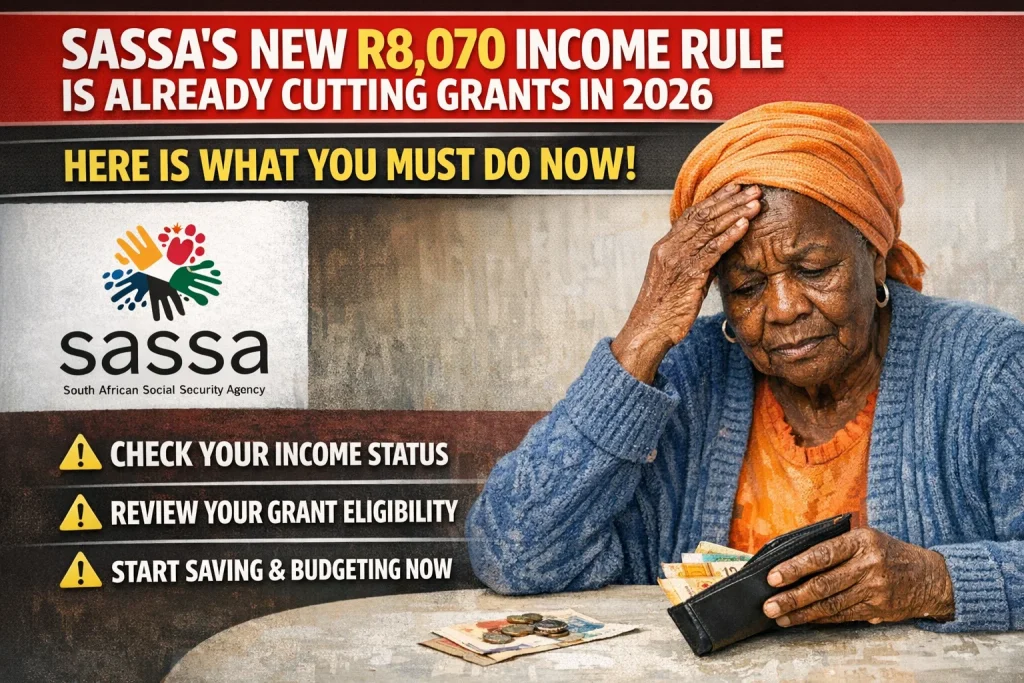
The South African Social Security Agency has revised its income eligibility threshold for means-tested social grants. Under the updated framework, individuals whose total monthly income reaches or exceeds R8,070 may no longer qualify for grant support.
This applies to the Old-Age Grant, the Disability Grant, the Care Dependency Grant, and the Child Support Grant. It is not a blanket cut. It is a stricter enforcement of income thresholds that were always part of the means test — but SASSA is now using far more sophisticated tools to verify them.
For married couples, the combined household threshold sits at R16,140 per month. If the combined household income crosses that line, eligibility for the grants becomes uncertain.
The rule came into effect on 28 February 2026 and is being used for all new applications and grant renewals processed from that date onward.
Why SASSA Introduced This Change Now
Here is what most articles do not tell you about this rule: the timing is deliberate.
By December 2025, SASSA had already reviewed approximately six million bank accounts and eight million credit bureau records as part of a broader compliance crackdown. The agency flagged nearly 292,000 beneficiaries for review and cancelled over 34,000 grants — saving an estimated R170 million. The R8,070 rule is the next logical step in that process.
The social grant budget for 2026/27 stands at R292.8 billion. With more than 28 million grant recipients across the country and below-inflation increases (the Old-Age Grant went up by just R80 this year, to R2,400), the government is under enormous pressure to ensure that every rand reaches people who genuinely qualify. Tightening the income threshold is one way to protect that.
That does not make it painless. It simply explains why it is happening.
What Counts as Income Under the New Rule?
This is where many beneficiaries get caught off guard. SASSA does not only look at your salary. The income assessment includes every regular financial inflow — salaries, informal or freelance earnings, pension payments from a previous employer, rental income, interest from savings accounts, dividends, and even consistent financial support from family members.
A seasonal construction job in December. A part-time market stall. Money transferred monthly by a child abroad. All of it can count. If your income fluctuates, you may need a sworn affidavit explaining the variation.
SASSA is now cross-referencing data with SARS, UIF, NSFAS, and banking records. The days of unverified declarations are effectively over.
What You Must Do Right Now
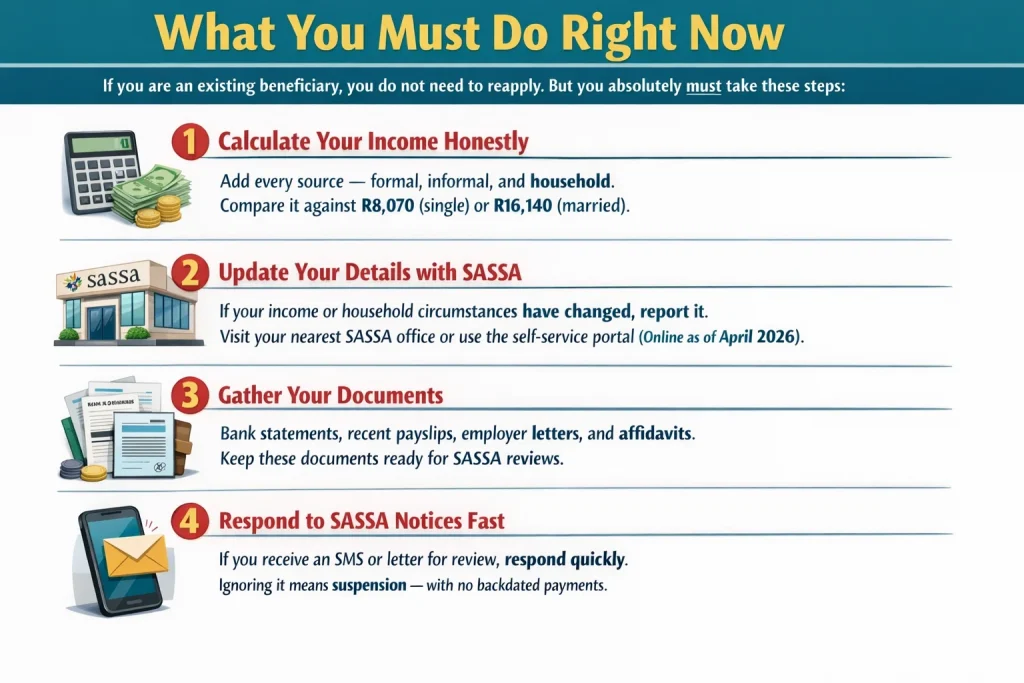
If you are an existing beneficiary, you do not need to reapply. But you absolutely must take these steps:
1. Calculate your total monthly income honestly. Add every source — formal, informal, and household. Compare it against R8,070 (single) or R16,140 (married).
2. Update your details with SASSA. If your income or household circumstances have changed since your initial approval, report it. You can do this at your nearest SASSA office or through the self-service portal, which is back online as of April 2026.
3. Gather your documents. Bank statements, recent payslips, employer confirmation letters, and sworn affidavits are all documents SASSA may request during a review. Keep them accessible and current.
4. Respond to any SMS or letter from SASSA promptly. If you receive a review notice, ignoring it leads to suspension — not just a delay. Suspension can take months to reverse, and there is no backdating of missed payments.
If Your Grant Is Suspended
A suspension is not the same as a cancellation. You have the right to appeal. Do it in writing or in person at your local SASSA office, and bring current income statements showing your earnings fall below the threshold.
If the high-income period was temporary — a once-off payment, a short contract, a gift — make that clear with supporting documentation. Grants can and do resume after a review confirms that eligibility has been restored.
The appeals window is three months from the date of suspension or cancellation.
FAQs: R8,070 SASSA Income Rule 2026
Does the R8,070 rule apply to all SASSA grants?
It applies to all means-tested grants — Old-Age, Disability, Care Dependency, and Child Support. The SRD grant uses a separate, simpler income check of R624 per month.
What if my income goes above R8,070 just one month?
A temporary spike can trigger a review, but it does not automatically cancel your grant. Submit an explanation and supporting documents showing the income was a once-off. SASSA can restore payments after verification.
Does my child’s income count toward my threshold?
If an adult child lives with you and contributes financially to the household, their income may be considered. SASSA looks at the household financial picture, not just individual income in isolation.
I earn informally. How does SASSA verify my income?
SASSA uses SARS and banking data. If your bank deposits consistently exceed R8,070, it raises a flag regardless of whether you are formally employed. A sworn affidavit explaining irregular income is your best protection.
Can I still own a home and qualify?
Yes. Your primary residence is excluded from the asset calculation. What counts is additional property, investments, vehicles, savings, and business assets.
What is the asset limit alongside the income limit?
For a single person on the Old-Age Grant, assets cannot exceed R1,524,600. For a married person, the limit is R3,049,200. Your home and basic household goods are excluded.
How do I update my income details with SASSA?
Visit your nearest SASSA local office with your ID and relevant income documents. You can also use the SASSA self-service portal online. Call the helpline on 0800 60 10 11 for guidance.
The Bottom Line
The R8,070 income rule is not designed to punish beneficiaries. It is designed — however imperfectly — to direct limited resources toward the households that need them most. But good intentions do not protect you from a suspension notice.
Review your income. Update your records. Keep your documents ready. The system will catch discrepancies whether you report them or not — and being proactive is always less painful than being reactive.
What has your experience been with SASSA income reviews in 2026? Share your story in the comments — it may help someone else navigate the process.


