

SASSA Tightens Grant Checks in 2026: Who Risks Payment Suspension and How to Stay Compliant
Imagine waking up on the third of the month, checking your bank balance, and finding nothing. No grant. No SMS explanation. Just silence, and a growing knot of panic in your stomach.
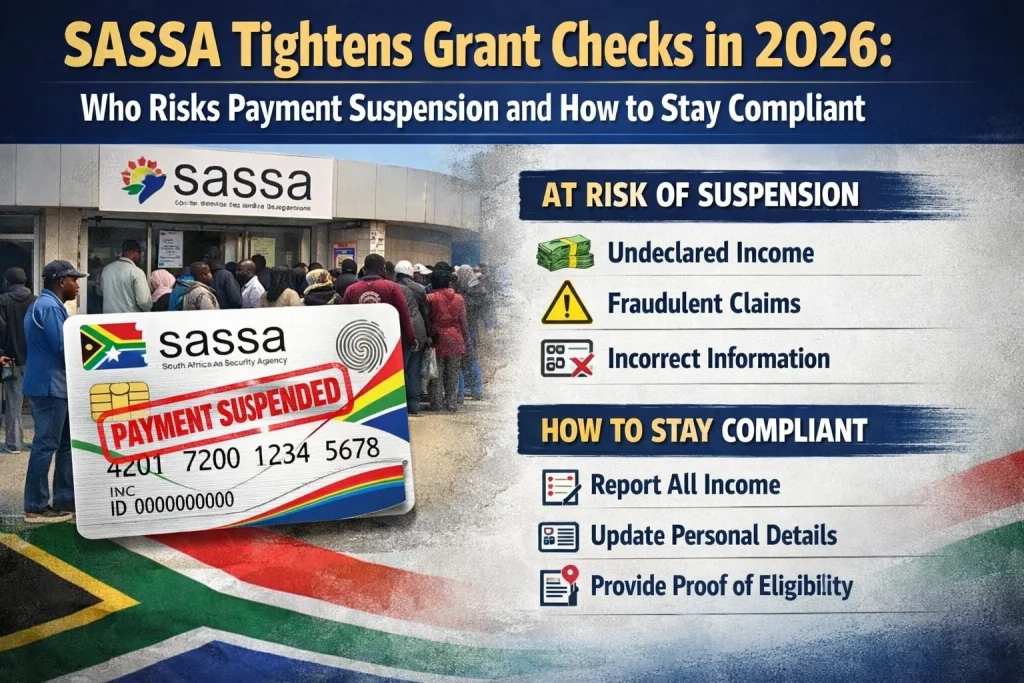
For thousands of South Africans in early 2026, that scenario stopped being hypothetical. About 70,000 grants have already been suspended for non-compliance, while nearly 400,000 beneficiaries have been notified that their eligibility is under active review. If you receive any form of SASSA support — Old Age, Disability, Child Support, or the SRD grant — what happens next matters enormously to your household.
Here is everything you need to know, clearly and without panic.
Why SASSA Is Tightening Checks Right Now
This is not a rumour, and it is not a once-off audit. It is a structural shift in how South Africa manages its social grant system.
National Treasury introduced stricter conditions for SASSA’s budget, including monthly income checks, expanded verification, and regular reporting to Parliament. In plain terms: the government tied SASSA’s funding directly to how well the agency roots out ineligible recipients. That created enormous institutional pressure to act fast and act decisively.
By December 2025, the agency had checked the bank accounts of about 6 million clients and 8 million credit bureau clients, flagging 291,581 grant beneficiaries for review. Those are not small numbers. They represent real people, real families, and real consequences.
The process has so far saved the government approximately R44 million a month — close to R500 million a year. Once Treasury sees savings at that scale, the verification drive is not stopping. It will deepen.
What Triggers a Review or Suspension
This is where most beneficiaries go wrong. They assume that as long as they have received a grant before, it continues automatically. That assumption is now dangerous.
SASSA has expanded its data-matching partnerships to include credit bureaus, banks, SARS, NSFAS, government payroll systems, and correctional services.These systems communicate constantly. If your financial circumstances changed and you did not report it, the database will likely catch the discrepancy before you do.
Common triggers for review include:
- Undeclared income, even part-time or informal earnings
- Double-dipping, such as receiving both an SRD grant and NSFAS funding
- Outdated contact details that cause missed verification notices
- Incomplete biometric enrolment, including fingerprint or facial recognition
- Government payroll data showing possible employment
In 2025 alone, nearly 210,000 people were flagged for receiving SASSA grants while also earning above the allowed income threshold, or receiving NSFAS student aid or employment benefits. The system flagged those cases automatically. No one needed to report them.
What Happens After You Are Flagged
Here is the part most articles skip, and it is the most important section on this page.
Grants are not cancelled automatically. Beneficiaries are given one month to complete a review after being notified. If they fail to appear, SASSA issues further notices before suspending the grant, followed by a final notice before cancellation. Beneficiaries may still lift a suspension by completing the review within the final month.
SASSA often extends these timeframes to accommodate beneficiaries who did not receive their notifications or were unable to visit local offices.
That is genuinely reassuring. The agency is not ambushing people without warning. But — and this is critical — if you ignore an SMS or a letter, the grace period expires and your grant stops. At that point, reinstatement requires effort, time, and in some cases a fresh application.
When unreported income is detected, SASSA may issue a compliance notice, temporarily place a payment hold, start a fraud investigation, or request repayment plans. Individuals who correct errors quickly often experience smoother resolutions.
Speed of response is your best defence.
How to Stay Compliant and Protect Your Grant
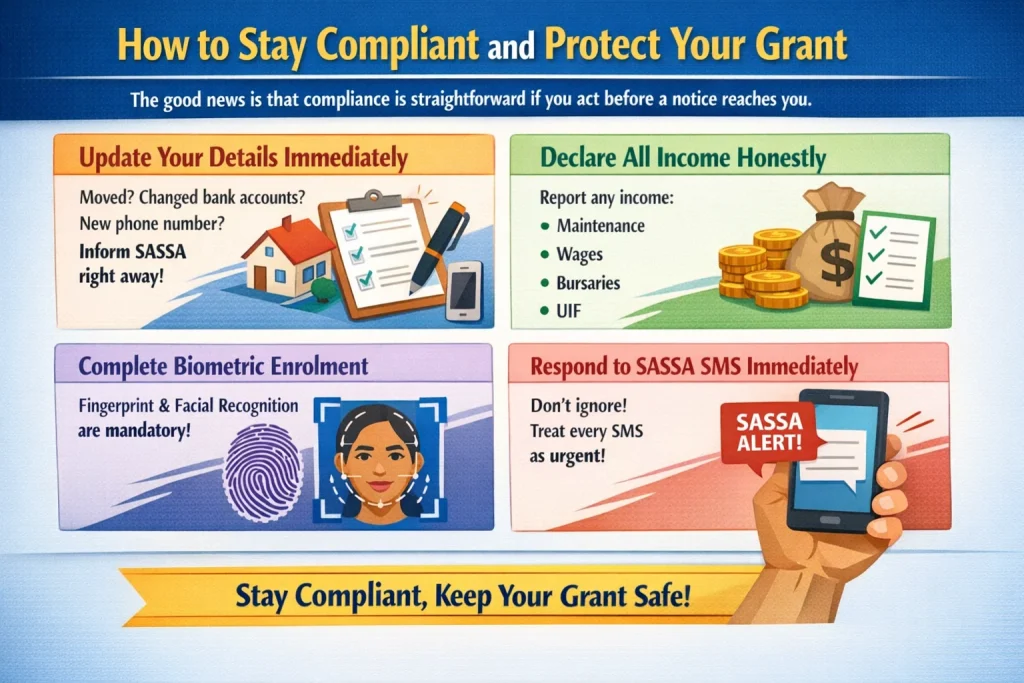
The good news is that compliance is straightforward if you act before a notice reaches you.
Update your details immediately. Many people have moved, changed bank accounts, or got a new phone number but never told SASSA. If your details are outdated, you might miss important communication, or your payment could bounce back and be marked “unclaimed.”
Declare all income honestly. Whether you receive child maintenance, UIF, part-time wages, or a government bursary, report it. The cross-referencing systems will find it regardless, and voluntary disclosure puts you in a far better position than a flagged account.
Complete biometric enrolment. The mandatory Beneficiary Biometric Enrolment — fingerprint or facial recognition — is now a cornerstone of the system. Beneficiaries who have not completed this process may have transactions halted until compliance is completed.
Respond to every SMS from SASSA immediately. Do not wait. Do not assume it is spam. Treat it as urgent correspondence.
The Bigger Picture: This System Is Here to Stay
SASSA’s allocation has been made conditional on the agency improving biometric and income verification processes, undertaking more frequent eligibility reviews, and implementing other measures to tighten compliance. That conditionality is baked into the budget cycle for years ahead.
Nearly 45% of the population depends on grants. That dependency makes the system both essential and vulnerable to abuse. The tightening of checks is the government’s response to both realities at once.
If your eligibility is genuine and your details are accurate, you have nothing to fear from this process. The beneficiaries losing grants are predominantly those with undeclared income, incorrect information, or who simply stopped responding to communication.
Stay visible, stay honest, and stay responsive. That is the entire compliance formula in three steps.
Frequently Asked Questions
Can SASSA suspend my grant without warning?
What if I missed an SMS because my number changed?
Visit your nearest SASSA office immediately with your ID and updated contact details. Offices are instructed to accommodate beneficiaries who missed notifications due to outdated information.
Can a suspended grant be reinstated?
Does part-time work automatically disqualify me from the SRD grant?
Not necessarily. Income thresholds apply, and the sliding scale adjusts grant amounts based on earnings. Declare your income and let SASSA calculate eligibility rather than assuming disqualification.
How do I update my banking details with SASSA?
Visit sassa.gov.za or your nearest SASSA office. Bring your ID document, proof of new banking details, and proof of address.
The SASSA grant system is tightening, and that process will continue well into 2027 and beyond. The beneficiaries who will keep receiving support are those who treat compliance as an ongoing responsibility, not a once-off task. Check your details today. It takes thirty minutes. The alternative could cost you months of support you genuinely need.


