

R720 School Grant Approved for March 2026: Important Details Parents Must Know Before Applying
Lerato is a single mother in Katlehong raising three school-going children. Every January, the back-to-school month drains her dry. Uniforms for three, stationery for three, transport money for three. By the time she pays the taxi fare for the first week of school, her Child Support Grant is already stretched to nothing. Last year, she discovered the R720 School Support Grant three months too late. She had no idea it existed. Her youngest was already wearing a broken shoe through the winter term before someone in her church group told her about it.

She is not alone. Thousands of qualifying parents miss this grant every year, not because they are ineligible, but because the information never reaches them clearly or early enough. This March, SASSA has confirmed the R720 School Support Grant for eligible beneficiaries, and if you have a school-going child in a low-income household, you need to read every word of this.
What Is the R720 School Support Grant?
The R720 School Support Grant is a financial assistance payment confirmed by SASSA for March 2026, designed specifically to help low-income caregivers cover back-to-school costs. The grant assists families with essential educational expenses including school uniforms, stationery, textbooks, and daily transport to and from school.

What makes this grant different from the standard Child Support Grant is its targeted purpose. The money is meant for educational costs, and SASSA has structured it as a per-child payment. Families with more than one qualifying child can receive multiple payments, provided each child independently meets the eligibility criteria. That means a household with two qualifying children could receive R1,440. Three children would bring R2,160. The total scales with your family size, which is significant relief at a time when school supply costs have risen sharply.
Who Qualifies for the R720 School Grant in March 2026?
Eligibility comes down to three core requirements. The caregiver must meet SASSA’s means test income threshold, meaning their household income must fall within the prescribed limits for social assistance. The child must be actively enrolled and attending an accredited South African school. And both the caregiver and child must have accurate, up-to-date personal information registered with SASSA.
Here is the detail that trips people up: every child in a multi-child household is assessed individually. You cannot simply declare that all three children qualify. Each child’s school enrolment, identity details, and relevant documents must be verified separately. If one child’s documentation is incomplete or inconsistent, that specific payment can be delayed or rejected while the others are approved.
Applications can be submitted through local SASSA offices and SASSA’s official online platforms, with the application window opening on 9 March 2026. Applying early matters. Applications processed first get through the verification queue faster, and documentation errors caught early leave time to correct before the payment window closes.
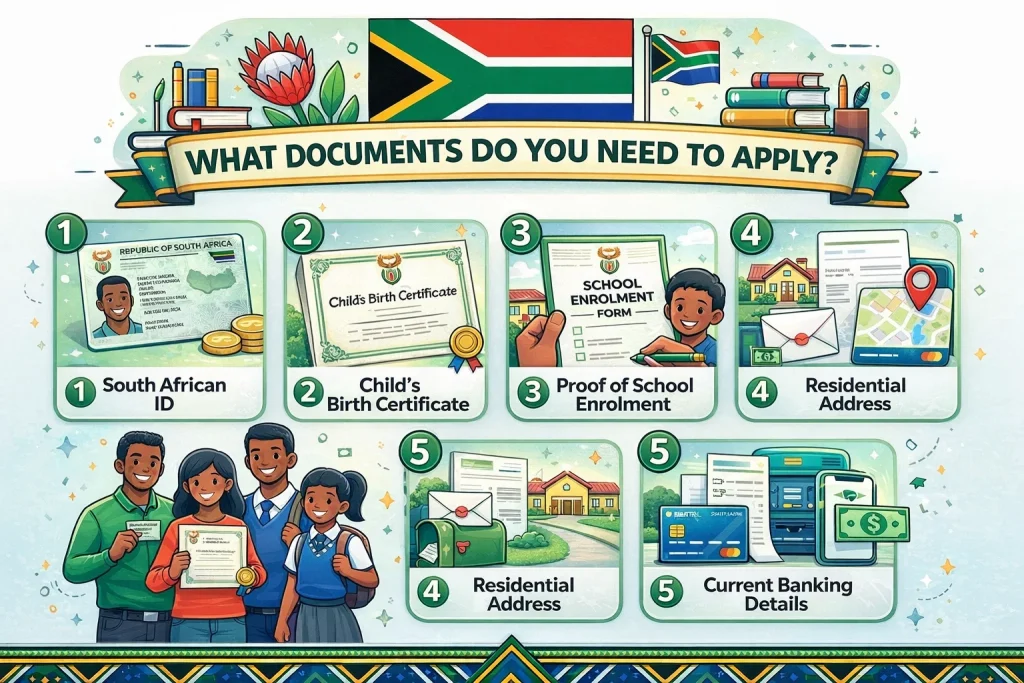
What Documents Do You Need to Apply?
Bring your South African ID or Smart Card, your child’s birth certificate, proof of school enrolment from the current academic year (a letter from the school principal on official letterhead works), proof of your residential address, and your current banking details. If your banking information has changed since your last SASSA interaction, bring your new bank statement too.
SASSA’s March 2026 compliance drive is running simultaneously with this payment cycle. Any mismatch between what is on your ID and what the school enrolment letter says can delay your application. Double-check your child’s ID number matches exactly across every document before you submit.
How Will the R720 Payment Be Made?
Payments are processed through standard SASSA methods: direct bank deposits, SASSA card transactions, and authorised retail payment points such as Pick n Pay, Shoprite, Checkers, and Boxer stores. There is no separate payment channel for the school grant. Once approved, the R720 per child deposits alongside your existing grant payment or as a standalone payment if you are a new applicant.
SASSA has issued a firm warning about scams targeting parents seeking school grant information. No payment requires a processing fee. No legitimate SASSA representative will ask for your banking PIN or a cash deposit to release funds. If anyone contacts you claiming to facilitate the R720 grant for a fee, report it immediately to the SASSA fraud hotline at 0800 60 10 11.
Do Not Make Lerato’s Mistake
Lerato applied for the school grant in October 2025, seven months after her youngest needed new shoes. Her application was approved in two weeks. All three children now qualify, and she receives R2,160 per cycle. She told her church group. Four other mothers applied the following month.
The grant was always there. The information just moved too slowly.
If you are reading this in March 2026, you are ahead of where Lerato was. The application window is open, the payment is confirmed, and the documents you need are straightforward to gather. The only thing standing between your child’s school costs and this relief is the decision to walk into a SASSA office or log onto the official portal this week.


