
Covid-19 SRD Grant 2026: Full History, Current Status and What Comes Next
It was April 2020. South Africa had just entered one of the strictest lockdowns in the world. Restaurants closed. Construction stopped. Informal traders lost everything overnight. Millions of working-age South Africans who had never received a government grant in their lives suddenly had no income and no safety net. The government had to act fast.
What followed was one of the most significant social policy decisions in post-apartheid South Africa. Within weeks, the Covid-19 Social Relief of Distress grant — commonly called the SRD grant or R350 grant — was born. Nobody knew it at the time, but that emergency measure would still be running six years later, supporting over eight million people every single month.
This is the complete story of how it started, where it stands in 2026, and what it means for the millions of South Africans who depend on it.
What Is the Covid-19 Social Relief of Distress Grant?
The COVID-19 Social Relief of Distress grant is available to those in need of temporary assistance who have insufficient means. It targets South African citizens, permanent residents, refugees, and asylum seekers whose section 22 permit or visa is valid, who are between 18 and 60 years of age, currently residing within South Africa, and not living in a government-funded or subsidised institution.
The name still says “Covid-19” in 2026. That is not a mistake or an oversight. It reflects the legal framework under which the grant operates — the Social Relief of Distress provisions of the Social Assistance Act. The name has stuck even as the pandemic itself faded, because the economic conditions that made the grant necessary never fully resolved.
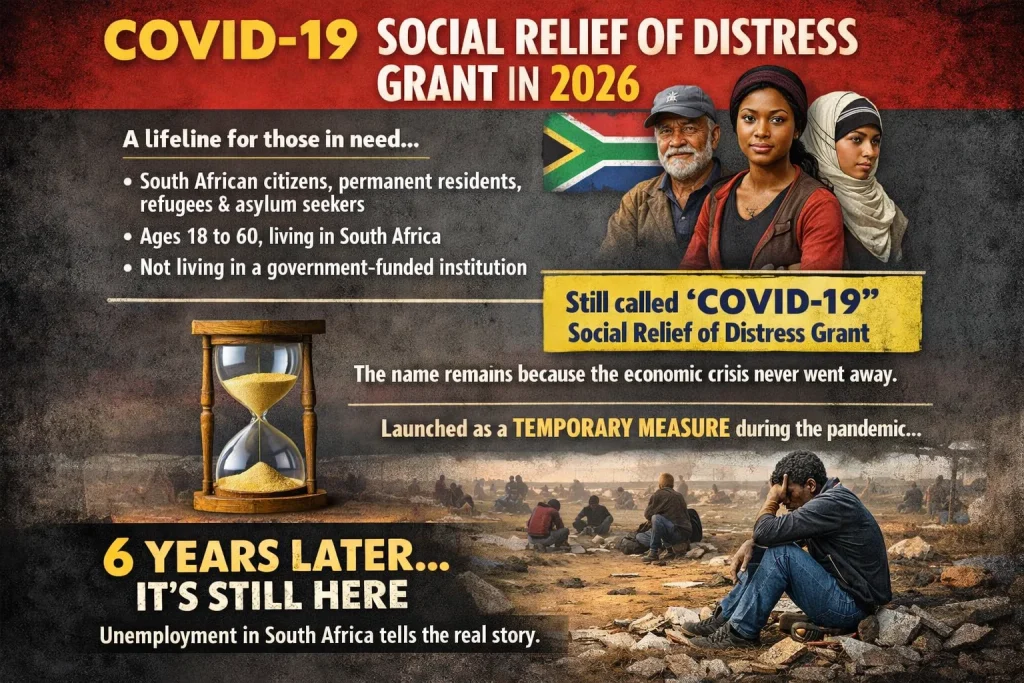
Here is the honest assessment most guides avoid: this was designed as a temporary emergency measure. Six years later it is still here, and that tells you everything about the state of unemployment in South Africa.
How Did the SRD Grant Start and How Has It Changed?
Initially launched during the COVID-19 pandemic with a value of R350, the grant has now increased to R370. The journey from R350 to R370 took years. The original amount was announced in April 2020 as a six-month emergency payment. Nobody expected it to outlast the pandemic itself. But over 9 million South Africans rely on this monthly payment to cover basic necessities like food, with 93% of recipients using it for groceries.
That statistic is staggering. It means this grant is not supplementary spending money. For the vast majority of recipients, it is the difference between eating and not eating.
Timeline of key SRD grant milestones:
| Year | Development |
| April 2020 | Grant launched at R350 per month during Covid-19 lockdown |
| March 2021 | Extended beyond initial six-month period |
| April 2022 | Amount increased to R350 with extended eligibility |
| April 2023 | Amount increased to R370 per month |
| March 2026 | Legal framework set to expire — extension confirmed |
| April 2026 | Extended at R370 until 31 March 2027 |
Is the SRD Grant Ending in 2026?
No. And the rumours suggesting otherwise need to be addressed directly.
The Department of Social Development has dismissed false claims circulating on social media suggesting that the COVID-19 Social Relief of Distress grant is set to be terminated. The department categorically stated that these claims are false and that there is no such decision, announcement or directive from the department or government regarding the termination of the SRD.
The extension, confirmed by the government, will run from 1 April 2026 to 31 March 2027, with the monthly payment remaining at R370. The decision comes as the current legal framework governing the grant was set to expire on 31 March 2026.
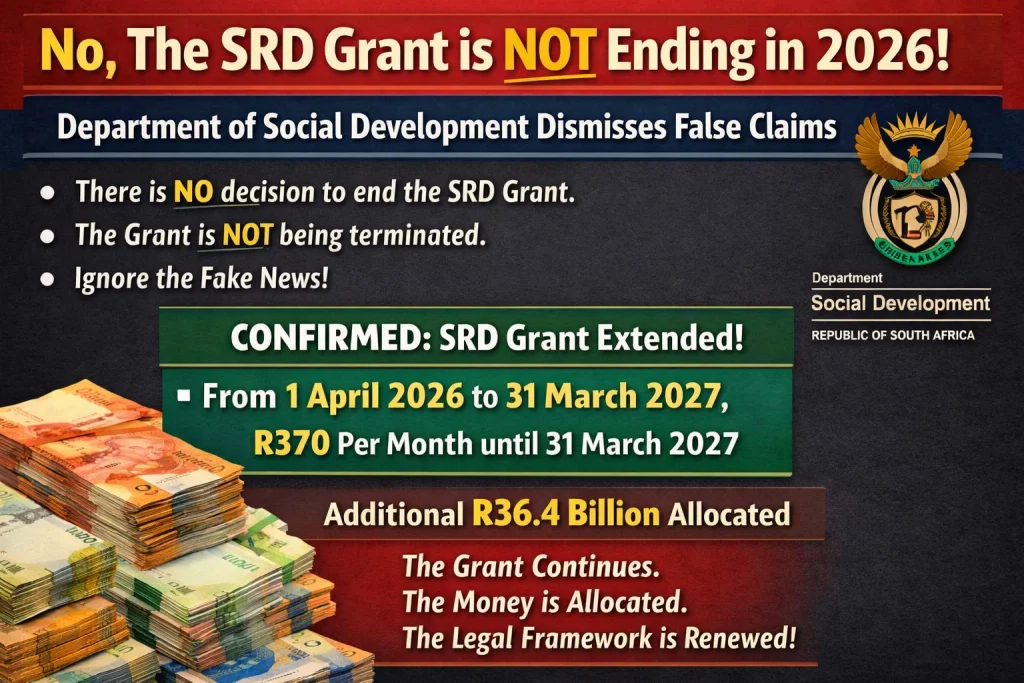
The social relief of distress grant is allocated an additional R36.4 billion to extend payments until 31 March 2027 at the current R370 per month per beneficiary.
The money is allocated. The legal framework has been renewed. The grant continues.
Why Did the SRD Grant Not Increase in April 2026?
This is the question that deserves a direct answer. Every other major SASSA grant received an increase from April 2026. All social grants, barring the COVID-19 Social Relief of Distress grant, will increase in the next financial year.
This extension reflects both immediate socio-economic needs and a longer-term policy transition, as the government explores redesigning the SRD grant into a more structured support mechanism linked to employment and skills development.
The freeze on the SRD amount is not accidental. It is a policy signal. Government is deliberately not entrenching the R370 figure while it builds the replacement system. Increasing the amount now would make the eventual transition to a jobseeker’s grant more politically and fiscally complicated.
That is the behind-the-scenes reasoning that most coverage skips entirely.
Who Qualifies for the SRD Grant in 2026?
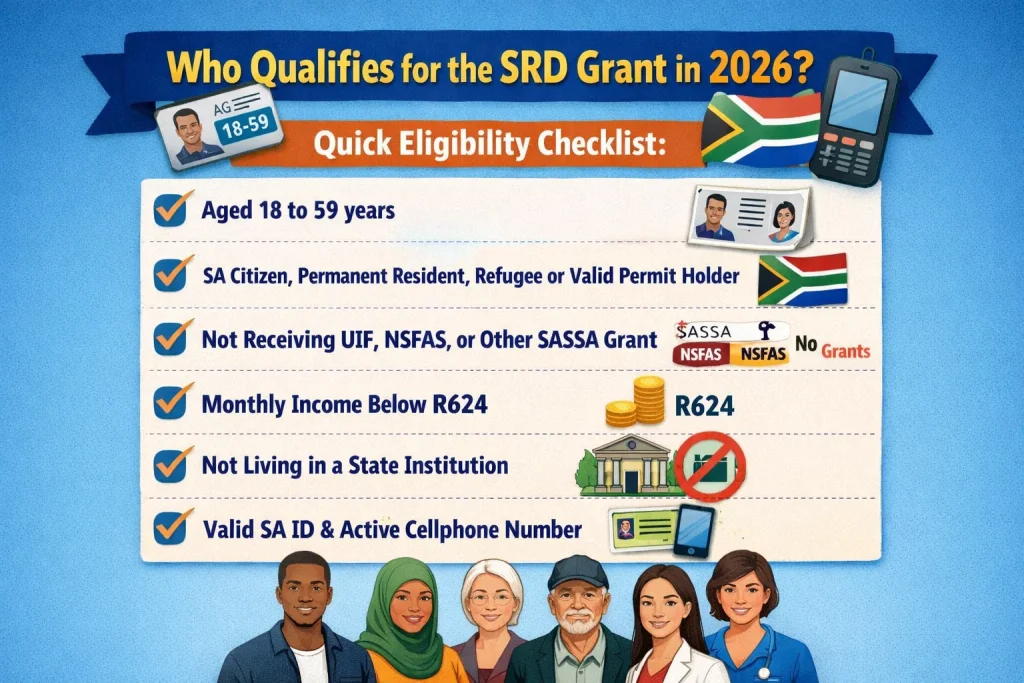
To qualify for the SRD grant in 2026 you must be a South African citizen, permanent resident, refugee, asylum seeker, or special permit holder. You must be between 18 and 59 years old. You must not be receiving any other form of social grant, NSFAS funding, or Unemployment Insurance Fund payments. You must not earn more than R624 per month as per the latest means test. You must have a valid South African ID and an active cellphone number.
Quick eligibility checklist:
- Aged 18 to 59 years
- South African citizen, permanent resident, refugee, or valid permit holder
- Not receiving UIF, NSFAS, or any other SASSA grant
- Monthly income does not exceed R624
- Not residing in a state-funded institution
- Valid South African ID and active registered cellphone number
What Is Happening to the SRD Grant Beyond March 2027?
This is the question every beneficiary is asking, and the answer is still being written.
In the coming months, attention is likely to shift toward policy discussions on the future of income support, including how the SRD grant can be integrated into broader economic strategies. The continuation of the grant highlights its importance within South Africa’s social protection system, even as its long-term role continues to evolve.
The provision for the SRD grant over the medium term dissipates to 2028/29, where only R1.7 billion and R1.2 billion are pencilled in over the outer years.
Read that carefully. The budget allocations for the SRD grant shrink dramatically toward 2028/29. That is not a clerical error. It is a planned phase-down, built into the medium-term expenditure framework while the jobseeker’s grant design is finalised.
The SRD grant as we know it today is almost certainly in its final form. What replaces it — and whether that replacement is better or worse for beneficiaries — is the defining social policy question of the next two years in South Africa.
How and When Does the SRD Grant Pay Each Month?
SASSA confirmed that payments for the COVID-19 Social Relief of Distress grant are made between the 23rd and 28th of each month. This end-of-month window is consistent across all payment months.
Available payment collection methods in 2026:
| Method | How to Access | Notes |
| Direct bank deposit | Registered bank account | Fastest and most reliable |
| Pick n Pay / Shoprite | Present ID at till | Available on payment release day |
| Checkers / USave / Boxer | Present ID at till | Good option in township areas |
| Post Office | Present ID and grant card | Queues can be long on release day |
| ATM withdrawal | SASSA-linked bank card | Available at all major ATM networks |
Check your status at srd.sassa.gov.za before the payment window opens each month. If your status shows approved with a confirmed date, your money is coming. If it shows pending or declined, act immediately — do not wait until after the window closes.
FAQ: Covid-19 SRD Grant 2026
Is the Covid-19 SRD grant the same as the R370 grant?
Will the SRD grant amount increase in 2026?
The SRD grant will remain at R370 per month and has been extended until 31 March 2027. Government has allocated an additional R36.4 billion to ensure payments continue in their current form. No increase has been announced for the current extension period.
Can I receive the SRD grant and the Older Persons Grant at the same time?
What happens if my SRD grant is declined this month?
Log in to srd.sassa.gov.za and check the reason for decline. Common reasons include a UIF payment reflecting on your profile, an income flagged through bank verification, or outdated personal details. You can lodge an appeal within 90 days of the declined status appearing on your profile.
Is it safe to use WhatsApp groups that offer to check your SRD status for a fee?
What replaces the SRD grant after March 2027?
Final Word: The Grant That Refused to End
The Covid-19 Social Relief of Distress grant was supposed to last six months. It has lasted six years. That says less about government generosity and more about the depth of unemployment in South Africa. Over eight million people still need it. The economy has not created enough jobs to make it unnecessary.
SASSA CEO Mr Themba Matlou welcomed the announcement that the COVID-19 Social Relief of Distress grant will continue in its current form, noting that this grant provides financial support and acts as a safety net for the most vulnerable in society and unemployed people who are of working age.
The grant is confirmed until March 2027. Beyond that, change is coming — whether in the form of a jobseeker’s grant, a basic income support system, or something else entirely. The best thing any current beneficiary can do right now is stay informed, keep their details updated, and apply for the jobseeker’s grant the moment it becomes available.
Your single priority action today: confirm your SRD status at srd.sassa.gov.za and verify that your registered cellphone number and banking details are still accurate before the next payment window opens.
Do you think the Covid-19 SRD grant should be permanently replaced with a higher basic income grant, or should government focus resources on job creation instead? Share your honest view below.